2026 Tuition Discount — Get $150 OFF Any Course Claim Now
EN ES

PRP Training in Philadelphia, PA

Gain CME credit while mastering PRP preparation and injection in a focused, one-day Philadelphia session.

View Upcoming Dates Call 866-261-5164

Tuition from $1,699 per workshop, supplies included. Questions? Call, chat, or request information.

25+Years Experience
50,000+Professionals Trained
CMEAccredited
2Upcoming in Philadelphia
MD Instructors
Small Groups (6 or Fewer)
Live Patient Practice
CME Credits Available
Post-Course Support

PRP (Platelet Rich Plasma) Training for Medical Professionals in Philadelphia

Philadelphia’s dense network of hospitals, academic centers, and aesthetic practices attracts clinicians who want to expand their non-surgical repertoire. With patients traveling from the Main Line, King of Prussia, Cherry Hill and Wilmington seeking advanced rejuvenation options, mastering platelet-rich plasma offers a versatile tool for facial rejuvenation, hair restoration, and scar improvement. The PRP course equips you to meet the growing demand while staying compliant with state regulations and CME requirements.

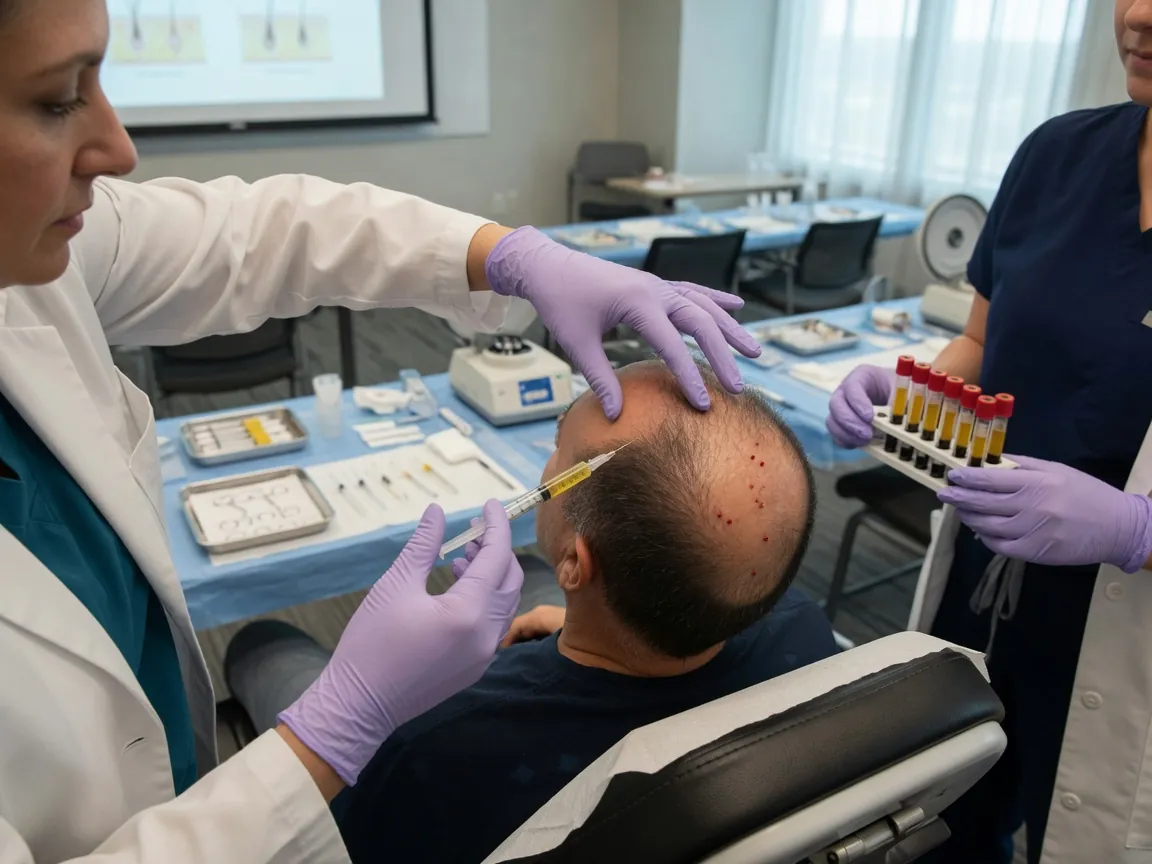
The curriculum begins with a review of patient selection, contraindications and after-care protocols, then moves to hands-on blood draw, centrifugation and preparation of both PRP and PRF. You will practice microneedling combined with PRP and master injection techniques for the face, followed by specific PRP protocols for hair restoration. Each skill is performed on live volunteers under direct MD supervision, ensuring you leave the day confident in delivering safe, evidence-based treatments.

Clinician performing a PRP scalp injection for hair restoration training

PRP (Platelet Rich Plasma) Training in Philadelphia, PA

Platelet-rich plasma (PRP) and platelet-rich fibrin (PRF) have become common options for patients seeking facial rejuvenation, hair restoration, and improvement of scars or stretch marks. This one-day, hands-on workshop in Philadelphia, PA trains licensed clinicians to prepare autologous plasma, understand its mechanism of action, and apply it safely in a variety of aesthetic indications. By mastering both injection and microneedling techniques, participants can address early-stage aging, thinning hair, and textured skin while offering a biologically based alternative to synthetic fillers.

The curriculum begins with online modules that cover the scientific background, equipment options, and patient selection criteria. On the hands-on day, typically 6-10 clinicians gather in a conference space within the Philadelphia metro area, where an MD educator leads a live demonstration followed by supervised practice stations. Each participant receives a printed manual, slide deck, and a collection of clinical studies and business documents to reference after the course. All activities comply with self-submitted CME Category II requirements, allowing physicians to claim credit through their own board.

Because Philadelphia is an academic medical hub serving Pennsylvania, South Jersey and Delaware, clinicians often encounter patients who ask for minimally invasive, evidence-based rejuvenation options. Adding PRP to an existing aesthetic portfolio allows physicians, nurse practitioners, and physician assistants to expand services without acquiring a new device inventory. The procedure complements dermal fillers, fat grafting, and laser treatments that are already popular in the region, helping practices meet the demand for natural-looking results and diversify revenue streams.

Who this course is for

  • Dermatology NPs adding PRP injections for facial rejuvenation in Philadelphia practices.
  • Physician assistants in aesthetic medicine seeking PRP training for hair restoration.
  • Dental surgeons adding PRP for soft-tissue rejuvenation in the Philadelphia metro area.
  • Medical RNs in aesthetic clinics who want to combine PRP with fillers and microneedling.
PRP Curriculum: What the Philadelphia Course Covers

MODULE 1

PRP Theory & Mechanism

Review platelet biology, differentiate PRP and PRF, discuss concentration levels, and explain mechanisms that drive tissue regeneration, supported by current clinical studies, including wound healing, collagen synthesis, and angiogenesis pathways.

MODULE 2

Equipment, Kits & Safety

Introduce available PRP kits and centrifuge options, outline safety protocols for blood handling, and clarify that the educator does not sell equipment, ensuring unbiased device selection.

MODULE 3

Blood Draw & Centrifugation

Demonstrate proper venipuncture technique, tube preparation, centrifuge settings, and step-by-step PRP/PRF separation, emphasizing sterility and accurate platelet concentration for consistent results, including timing parameters and troubleshooting common issues such as layer instability.

MODULE 4

Facial Injection & Microneedling

Teach injection planes, volume selection, needle angle for facial PRP, and microneedling device settings, followed by after-care protocols to minimize bruising and optimize patient comfort.

MODULE 5

Hair Restoration & Other Indications

Outline PRP protocols for scalp treatment, scar revision, acne-related lesions, and stretch-mark improvement, focusing on patient selection, contraindications, and expected outcome timelines, including session frequency and post-procedure care recommendations.

MODULE 6

Combining PRP with Fillers, Fat & Laser

Explain strategies to use PRP sequentially or simultaneously with dermal fillers, fat grafting, fractional laser, and microneedling to enhance healing and prolong aesthetic results in the same treatment session.

The hands-on day in Philadelphia

  1. Check-in begins with a brief review of online module content and a patient safety checklist for the day.
  2. The educator delivers a live demonstration of blood draw, centrifugation, and PRP injection techniques on a model.
  3. Participants rotate through supervised stations, preparing PRP, practicing facial injections, microneedling, and hair-scalp protocols under MD guidance.
  4. The day concludes with a debrief, Q&A session, distribution of manuals and certificates, and next-step recommendations.

What You Learn in the PRP Course

  • Blood draw, centrifugation and PRP / PRF preparation
  • Microneedling with PRP and PRP injection techniques for the face
  • PRP protocols for hair restoration
  • Patient selection, contraindications and aftercare
  • Hands-on practice under direct MD supervision

Full PRP Training Curriculum →

Upcoming PRP Training Dates in Philadelphia, PA

All courses include hands-on training with live patients under direct MD supervision

DATE
LOCATION
COURSE
SUN
OCT 25
Philadelphia, PA
PRP Training for Aesthetics
by: Empire Medical Training
SUN
APR 112027
Philadelphia, PA
PRP Training for Aesthetics
by: Empire Medical Training

How PRP Training Works in Philadelphia

The program is divided into two parts. First, you complete online didactic modules at your own pace, covering theory, safety and protocol guidance. Once the modules are finished, you attend a single hands-on day hosted at a hotel or conference venue in the Philadelphia metro area. Small groups of practitioners from Philadelphia, the Main Line, King of Prussia, South Jersey and Delaware practice PRP preparation and injection together under MD supervision.

Why Take PRP Training in Philadelphia?

Live patient practice on Philadelphia volunteers

CME credit available where the course qualifies

Small group format ensures individualized feedback

Focus on facial, hair and scar applications of PRP

Convenient location serving Philadelphia, Main Line and South Jersey

How PRP Certification Works

Your path to PRP certification in Philadelphia in 4 steps

1

Reserve Your Date

Choose your Philadelphia training date and then call 866-261-5164, chat or send the form to confirm your seat.

2

Complete Online Modules

Study the didactic curriculum on demand and pass the post-test before your hands-on date.

3

Hands-On Training

Attend the in-person session in Philadelphia and practice on live patients under direct MD supervision.

4

Get Certified

Receive your certificate and CME credits, plus post-course support from our clinical team.

After the PRP Course

After completing the workshop, clinicians receive a certificate of completion, the full slide deck, a printed manual, and a library of clinical studies and business documents. The materials enable immediate integration of PRP for facial rejuvenation, hair restoration, and scar treatment into your practice. Ongoing email support and access to an online forum provide answers to technical questions and assistance with protocol refinement. Remember that the ability to perform PRP depends on your professional license and the regulations of your state board, so verify eligibility before offering the service.

Check the upcoming PRP training dates in Philadelphia and call, chat, or request more information today. See dates · 866-261-5164 · Request information

PRP Training in Philadelphia: Frequently Asked Questions

Who is eligible to attend the PRP training in Philadelphia?

MDs, DOs, nurse practitioners, physician assistants, registered nurses and dentists may enroll, provided they hold an active license in Pennsylvania or a neighboring state. Eligibility depends on your license and state regulations; please verify with your state board or contact our admissions team for confirmation.

Where are the training sessions conducted in the Philadelphia metro?

Both the online didactic modules and the one-day hands-on session are delivered within the Philadelphia metro area. The practical day takes place at a centrally located hotel or conference facility, providing easy access for clinicians traveling from the city, the Main Line, King of Prussia, Cherry Hill and Wilmington.

What is included in the hands-on portion of the PRP course?

You will draw blood, spin it in a centrifuge to separate PRP and PRF, and then perform microneedling and injection techniques on live volunteers. The day covers facial rejuvenation, hair restoration and scar treatment protocols, all under direct supervision of a board-certified MD.

What do I receive after completing the PRP training in Philadelphia?

Upon successful completion you earn a CME certificate that can be added to your professional record, and you receive a digital badge. Ongoing support includes access to post-course materials, a practitioner forum and opportunities to attend advanced aesthetic workshops.

Aesthetic.Education | The Next Step in Medical Learning

FREE 2026 GUIDE

Get the complete course catalog — pricing, dates & a $150 discount code inside.

Aesthetic Treatment & Career Guides

Patient-friendly references our students use to explain procedures and career paths.