Pennsylvania clinicians looking to expand their aesthetic skill set will find this guide covering the upcoming hands-on injectable workshop in Philadelphia, tuition breakdowns, reservation methods, and practical travel considerations. Whether you practice in the suburbs of Pittsburgh, the Lehigh Valley, or the state capital, the page outlines what to expect.
View Upcoming Dates Call 866-261-5164There is no federal licence or national certificate for cosmetic injectables in the United States. Each state decides, through its own licensing boards, which professionals may inject, under what supervision, and after what training. The table below is the general pattern across the country; Pennsylvania sets its own version of these rules, so treat it as orientation and confirm the detail with the boards listed further down.
| Licence | How injectables usually sit in their scope |
|---|---|
| Physician (MD, DO) | Generally may perform aesthetic injections within their training and competence, and in most states may delegate them to other qualified staff. |
| Nurse practitioner (NP) | Usually injects under the practice authority their state grants, which in some states is independent and in others involves a collaborating physician. |
| Physician assistant (PA) | Typically injects under a supervising physician relationship as defined by the state. |
| Registered nurse (RN) | Commonly injects under a physician's order, delegation or written protocol, with the patient assessment performed by the delegating prescriber. |
| Dentist (DDS, DMD) | Scope varies more than for any other licence. Some states limit dental injectables to the oral and maxillofacial region; others read the dental practice act more broadly. |
Because there is no single national credential, boards generally look for documented, hands-on training appropriate to the procedure and the licence: supervised practice on live patients rather than an online-only certificate, facial anatomy and danger zones, patient assessment and consent, and complication management including how to reverse a hyaluronic acid filler. Keep your certificate of completion, the course agenda and a record of your supervised injections on file.
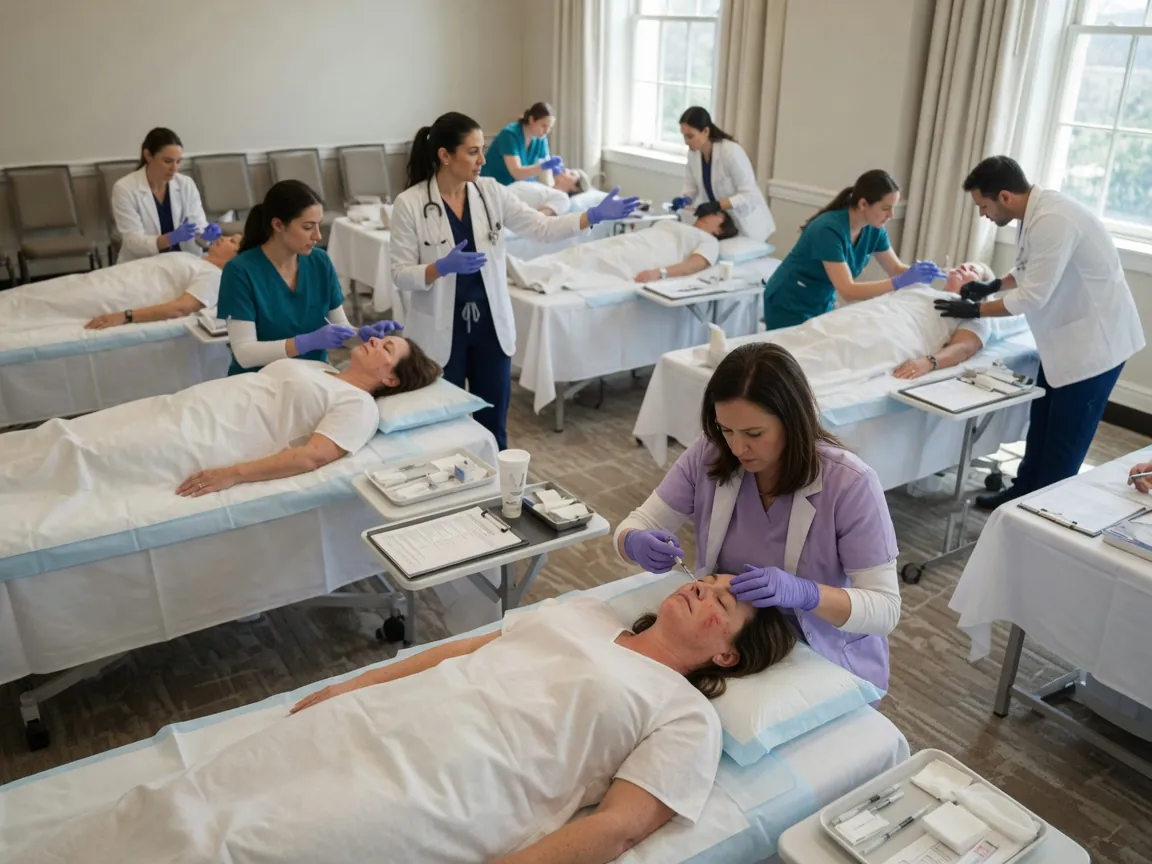
The workshops listed on this site are taught by physician instructors in groups of six or fewer, combine online modules with a hands-on day on live patients, and issue a certificate of completion, with CME credit where the course qualifies. Tuition starts at $1,699 for a first workshop.

Your board is the only authority that can answer for your licence. Contact them directly and ask:
These directories are maintained by the professional bodies themselves and always point to the current board for every state.
Reserve a seat by phone, chat or the information form; an advisor confirms your date and city.
Across the next scheduled months there are 21 hands-on dates in Pennsylvania, in 1 city, from October 2026 to June 2027. This is what those dates cover:
| COURSE | Dates in PA |
|---|---|
| Botox Training | 4 |
| Dermal Filler Training | 4 |
| Hair Loss Treatment Training | 2 |
| PRP Training | 2 |
| Advanced Botox & Filler Training | 2 |
| Facial Contouring Injectables | 2 |
| Botox + Filler Combo Training | 1 |
| Complete Facial Aesthetics | 1 |
| Sclerotherapy Training | 1 |
| Kybella & Mesotherapy Training | 1 |
Pennsylvania's major metropolitan hubs - Philadelphia, Pittsburgh, and the Harrisburg-Lancaster corridor - host a growing clientele seeking cosmetic injectables, driven by a mix of urban professionals and aging baby-boomers. Philadelphia's dense population and high disposable income support a robust aesthetic market, while Pittsburgh's expanding healthcare community and the central Pennsylvania region's rising interest in non-surgical rejuvenation add steady demand. Seasonal events and social media trends further boost appointment bookings across these areas. Local clinics often schedule multiple providers per day to accommodate the flow, and the competitive landscape encourages ongoing education.
Hands-on sessions are held in Philadelphia, making it the central point for Pennsylvania-based clinicians. Those living in Pittsburgh typically opt for a short flight (≈1.5 hours) to the city's airport, while practitioners from Harrisburg or the Lehigh Valley often drive 2-3 hours on interstates I-76 or I-78. Scheduling the Philadelphia workshop alongside another regional conference or product demo can maximize travel efficiency and reduce overall costs.
Aesthetic.Education | The Next Step in Medical Learning
Patient-friendly references our students use to explain procedures and career paths.