2026 Tuition Discount — Get $150 OFF Any Course Claim Now
EN ES

Pain Management Training: Injections, Biologics & Ultrasound

Master interventional pain techniques with injections, biologics, and ultrasound in a focused, hands‑on workshop.

View Upcoming Dates Call 866-261-5164

Tuition from $1,699 per workshop, supplies included. Questions? Call, chat, or request information.

25+Years Experience
50,000+Professionals Trained
6Max per Group
26Upcoming Dates
MD Instructors
Small Groups (6 or Fewer)
Manual, Slides & Protocols Included
Certificate of Completion
Post-Course Support

Upcoming Pain Management Training Dates

Reserve a seat by phone, chat or the information form; an advisor confirms your date and city.

DATE
LOCATION
COURSE
SAT
SEP 19
Dallas, TX
Pain Management Training (The Pain Show)
by: Empire Medical Training
SAT
NOV 7
Orlando, FL
Pain Management Training (The Pain Show)
by: Empire Medical Training
MON
NOV 9
Online Livestream
Advanced Ultrasound for Pain Management
by: Empire Medical Training
SAT
JAN 232027
Los Angeles, CA
Pain Management Training (The Pain Show)
by: Empire Medical Training
FRI
JAN 292027
Las Vegas, NV
SAT
JAN 302027
Las Vegas, NV
SUN
JAN 312027
Las Vegas, NV
SAT
FEB 202027
Orlando, FL
Pain Management Training (The Pain Show)
by: Empire Medical Training
SAT
FEB 202027
Newark, NJ
Pain Management Training (The Pain Show)
by: Empire Medical Training
SAT
MAR 132027
Las Vegas, NV
Pain Management Training (The Pain Show)
by: Empire Medical Training
SAT
MAR 202027
Online Livestream
SUN
MAR 212027
Online Livestream
MON
MAR 222027
Online Livestream
FRI
APR 162027
Atlanta, GA
SAT
APR 172027
Atlanta, GA
SUN
APR 182027
Atlanta, GA
FRI
APR 302027
Orlando, FL
SAT
MAY 12027
Orlando, FL
SUN
MAY 22027
Orlando, FL
FRI
MAY 72027
Online Livestream
SAT
MAY 82027
Online Livestream
SUN
MAY 92027
Online Livestream
SAT
JUN 52027
Long Island, NY
Pain Management Training (The Pain Show)
by: Empire Medical Training
FRI
JUN 182027
Atlanta, GA
SAT
JUN 192027
Atlanta, GA
SUN
JUN 202027
Atlanta, GA

About the Pain Management Course

This workshop addresses the growing need for effective, minimally invasive options for musculoskeletal pain. Participants will explore joint and extremity injection techniques, trigger point therapy, ultrasound‑guided procedures, and the use of autologous conditioned plasma and other biologics. The curriculum also covers patient selection criteria, documentation standards, and basic coding principles to help clinicians integrate these services safely and efficiently into their practice. By mastering these modalities, clinicians can offer patients alternatives that may reduce reliance on oral medications and surgery.

Instruction combines focused didactic sessions with extensive hands‑on practice. Live models are used for injection workshops under direct supervision, allowing participants to refine needle placement and ultrasound imaging skills in real time. Each module presents a specific technique—ranging from basic joint injections to advanced biologic applications—followed by guided practice and immediate feedback. Supplemental course materials and a certificate of completion are provided to reinforce learning after the workshop concludes successfully.

This program attracts board‑eligible physicians, advanced practice providers, nurses, and dentists who are expanding into interventional pain management. Participants seek practical skills to safely perform injections, incorporate ultrasound guidance, and understand emerging biologic therapies. The hands‑on focus appeals to clinicians who prefer experiential learning over purely lecture‑based formats, and the inclusion of coding basics supports those preparing to bill for these procedures within their practice environment. It also provides confidence in documenting and coding these services for long‑term practice sustainability.
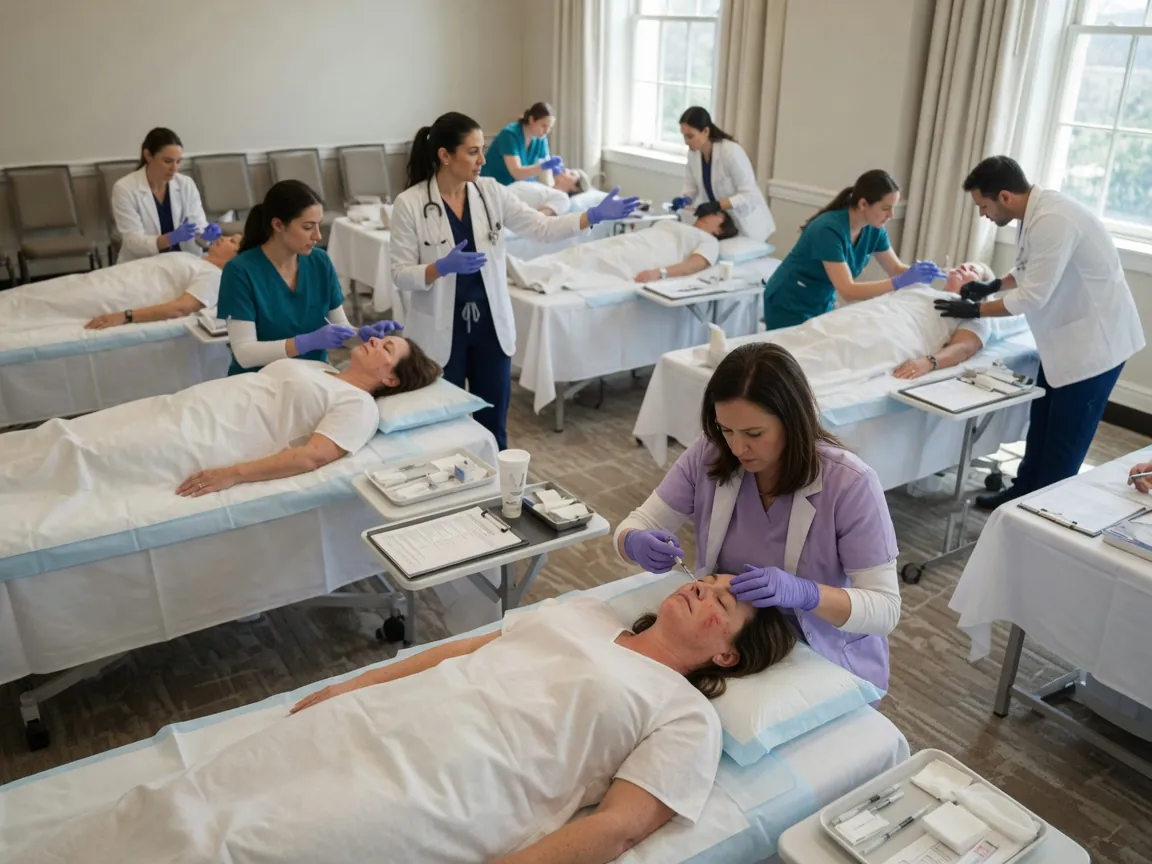

Pain Management training session

What You Learn

  • Perform accurate joint and extremity injection techniques with confidence.
  • Execute trigger point injections for localized musculoskeletal pain.
  • Apply real‑time ultrasound to guide needle placement safely.
  • Prepare and administer autologous conditioned plasma and related biologics.
  • Assess patient suitability and develop appropriate treatment plans.
  • Document procedures and follow basic coding guidelines for reimbursement.

Who This Course Is For

  • Physicians expanding into interventional pain services.
  • Advanced practice providers seeking hands‑on injection training.
  • Nurse practitioners aiming to add ultrasound‑guided procedures.
  • Dentists interested in biologic therapies for orofacial pain.

Curriculum: What the Pain Management Course Covers

MODULE 1Introduction & Clinical Context

Overview of musculoskeletal pain challenges and the role of minimally invasive interventions. Discusses indications, benefits, and safety considerations that frame for subsequent hands‑on training modules.

MODULE 2Joint & Extremity Injection Techniques

Detailed instruction on needle placement for common joints and extremity sites. Includes step‑by‑step demonstration, anatomy review, and safety tips to achieve accurate therapeutic delivery consistently.

MODULE 3Trigger Point Injection Methods

Focuses on identification of myofascial trigger points and injection techniques to alleviate localized pain. Participants practice palpation skills and needle handling on live models under supervision.

MODULE 4Ultrasound Guidance Fundamentals

Covers principles of ultrasound physics, image optimization, and anatomy localization. Learners acquire real‑time scanning skills and apply them to guide injections safely and accurately during procedures.

MODULE 5Autologous Conditioned Plasma & Biologics

Introduces preparation, handling, and injection protocols for autologous conditioned plasma and other biologic agents. Emphasizes safety, dosage considerations, and integrating biologics into multimodal pain regimens.

MODULE 6Documentation, Patient Selection, and Coding Basics

Reviews criteria for appropriate patient selection, proper documentation standards, and introductory coding concepts. Provides templates and examples to support compliant billing for interventional procedures within your practice.

Pain Management Certification for Nurses & Nurse Practitioners

Registered nurses, nurse practitioners and physician assistants make up a large share of every Pain Management course. The curriculum is the same for every clinician: online didactic modules first, then a hands-on day where you treat live patients in a small group under direct physician supervision, and a certificate of completion with CME credits at the end.

What you can do with the training afterwards depends on your license and your state. In many states RNs perform aesthetic injections under a physician or nurse practitioner's delegation and supervision, while NP and PA scope varies by state and practice agreement. Before you enroll, confirm the rules with your state board of nursing or medicine; our admissions team can also walk you through what other nurses in your state have done.

  • Same hands-on protocol and live-patient practice for RN, NP, PA, MD, DO and DDS attendees
  • Documentation you can show an employer or supervising physician: certificate, CME credits and course syllabus
  • Post-course support from the clinical team for questions that come up in your first cases

Read: Botox training for nurses, what to expect · Can LPNs take injectable courses? · See upcoming dates

Pain Management Training: Frequently Asked Questions

The workshop welcomes licensed clinicians such as physicians (MD or DO), nurse practitioners, physician assistants, registered nurses, and dentists who are interested in expanding their practice to include interventional pain techniques. Eligibility depends on your professional license and state regulations; confirm with your state board or the admissions team.
The training combines concise didactic sessions with extensive hands‑on practice on live models under medical supervision. Participants receive comprehensive course materials, a certificate of completion, and ongoing access to reference guides to support skill retention after the workshop.
There are no formal prerequisite courses, but participants should have a basic understanding of musculoskeletal anatomy and be comfortable with aseptic technique. Current clinical licensure is required, and attendees should bring any personal protective equipment they typically use in practice.
After successful completion, clinicians may incorporate joint, extremity, trigger point, and ultrasound‑guided injections as well as autologous conditioned plasma and related biologic therapies into their treatment options. Scope of practice varies by professional license and state law; verify eligibility with your state board or the admissions team.
To reserve a spot, contact the admissions office by phone, live chat, or by submitting a request for information through the website. An admissions representative will confirm availability, provide next steps, and answer any additional questions you may have.

After the Course

Upon finishing the workshop, participants receive a certificate of completion and a complete set of course materials, including procedural checklists and reference guides. Ongoing support is available through email correspondence with faculty for troubleshooting and clarification. Remember that the ability to perform any of the taught techniques depends on your licensure and state regulations; always verify compliance before offering services to patients.

Cancellation Policy

All cancellations must be received in writing. A refund, less a $200 processing fee, is given for cancellations received at least 14 days before the workshop; later cancellations can be applied to a future workshop with administrative approval. If a course is cancelled for any reason, the registration fee is refunded in full.

Other Medical Courses

Aesthetic.Education | The Next Step in Medical Learning

FREE 2026 GUIDE

Get the complete course catalog — pricing, dates & a $150 discount code inside.

Aesthetic Treatment & Career Guides

Patient-friendly references our students use to explain procedures and career paths.